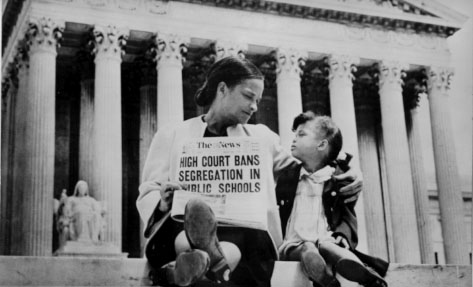
The day after "Brown v. Board of
Education" was announced,
Nettie Hunt sat on the steps of
the U.S. Supreme Court and
explained the decision to her
daughter, Bettman/Corbis, 1954
|
Prior to the Brown v. Board of Education decision, the existence of racial discrimination in the United States impacted the country’s global role as an advocate for equality and protector of democracy. On May 17th, 1954, the
Supreme Court ruled that racial segregation in American schools were unconstitutional, thus also declaring that the Plessy v. Ferguson decision (“separate but equal”) also unconstitutional. The ruling created massive resistance from white southern democrats who rejected the Brown decision and defended segregation, claiming that the courts were abusing their power by creating the laws instead of interpreting it. |
|