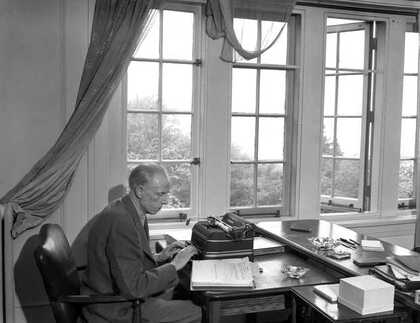
Sinclair Lewis at typewriter, June 13, 1944, Minnesota Historical Society
|
Harry Sinclair Lewis, the first American to win the Nobel Prize for Literature, was born in Sauk Centre, Minnesota in 1885. He became a best-selling author when his fifth novel, Main Street, was published in 1920. Based on Lewis’ hometown, Main Street told the story of Carol Kennicott, a young woman who moves with her husband to rural Minnesota, where she struggles to bring arts, culture, and tolerance to the small town. Considered an example of feminist writing and a criticism of small town life, Main Street was the first of Sinclair Lewis’ five major 1920s novels. Although he turned down the Pulitzer Prize in 1926 to protest the organization’s requirement that novels must present the “wholesome atmosphere” of America, Lewis’ acceptance of the Nobel Prize in 1930 brought him international fame. Although his reputation fell until his death in 1951, his criticisms of greed, intolerance, and closed mindedness influenced later American writers. In the late 2010s, one of his later novels, It Can’t Happen Here, became a best-seller for its warnings of the possible rise of fascism in the United States.
|
Sources to Get Started |
|